
From a diary note, after a massive break-up
December, 2022

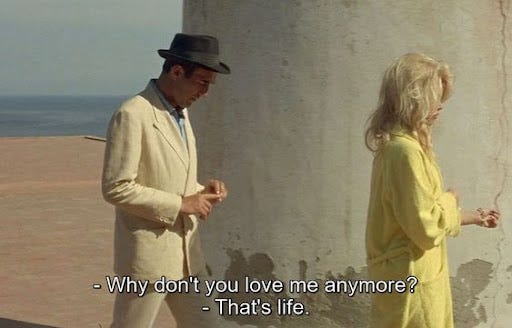
There’s a famous scene in Godard’s Contempt. On the famous terrace of Villa Malaparte, Piccoli (Paul) asks Bardot (Camille), “Why don’t you love me anymore?” Camille responds, “That’s life.”
The list of lessons learned in 2022 keeps getting longer, and no matter how many times I try to put a period on it, it doesn’t sit right with me. I’m not one to make year-end evaluations—I’d probably make fun of it in the past. But as those closely following me would know, this year was an eight-Oscar-worthy drama. Apple doesn’t help either, constantly shoving reminders in my face—"six months ago," "nine months ago." I’m chuckling as I write this, yet I’m still amazed it’s over, that it could even end. (It’s over, it’s over, let it go.) So I thought, instead of making a list, I’d write about it this time—maybe that’ll help.
Yesterday, while chatting with Ayşegül on the balcony of the house where I’m currently staying—we were tossing ideas back and forth about what we’ve learned—she repeated something she’s been saying a lot lately: “Things can change in five minutes.” Initially, I frowned, but this time I laughed and looked straight ahead. I’m now staying directly across the street from the home I was dumped in one morning, seven months ago—a home I painstakingly built after years of wandering, where I thought I’d spend years, where I even considered baby names. I tore it apart sobbing and closed that chapter. Now, right across from it, I’m staying in a room where I see the same street, the same sign, the same grocer, the same honey seller, the same barber, the same corner store, the florist, and the same coffee shop. Occasionally, my gaze drifts there, and then I laugh. Memory is an interesting machine—mine must have been made by Germans; it works like a beast. When this first break-up happened, as if the emotional wreckage weren’t enough, I didn’t even have a penny in my pocket. I went to Fethiye and washed dishes as a volunteer for 20 days. Now, looking at the kitchen today, there’s food, but the dishes have piled up again. I’m still a volunteer—thankfully. For someone who has devoted their entire perception to images and words, this physical counterpart has forced me over time to reevaluate the ways I see things.
The necessity of having more than two eyes to truly see is an intriguing part of the emotional evolution of existence. A hunter must see their prey with their eyes, but the heart can only see another heart with its own. This perspective on the eye contact of hearts aligns with Jung’s assertion: “The meeting of two personalities is like the contact of two chemical substances: if there is any reaction, both are transformed.” However, I am not talking about a specific person or even a person per se. I am pointing out that everything seen has a heart of its own. Including the street.
Returning to perception... The events we experience don’t change. I tried hard to see things from other angles, from the eyes of the heart, with grace. But no, it doesn’t work. Some things are ugly in their essence; some people are bad; some memories are painful; some losses are unfair. Some things have no meaning at all, while others have meaning worthy of a thousand volumes. When viewed slowly, not from center stage but from the back of the theater or even from the top, a person who constantly lives forward due to the passage of time is forced to reevaluate these traumas, soften them, and emerge from them with love. These some things can suddenly take on their opposite meanings—beautiful, good, sweet, gain. I call this the beautification of healing. You survive.
Trauma is comprehension.
The meaning we give to an event is variable; emotions are variable; ideas change—things can indeed change in five minutes or even five seconds. But comprehension is deep-rooted and constant. Still, one must ask: “Don’t roots, when torn from their foundation, long to be free? Did trees ever truly wish to have roots?” In other words, can the variability of comprehension and trauma—their dependence on love and the ability to love—be accepted?
Comprehension, derived from the Arabic word dark, darak, comes from the root meaning “arrival, reaching, the bottom point of something.” The bottom point of anything is the heart. And the bottom point of the heart is love.
In the play where I restart everything from scratch, unfolding at a pace far from the magical speed of movies, I think I’m not doing too badly. Julia Roberts might lose her role to me in Eat, Pray, Love. With the end of the year comes the season finale. Thankfully, my appetite has returned. Trips to Lesbos and Şeb-i Arus kicked off the praying section. The love part remains questionable. I can’t seem to leave my cave, and I think I’ve overdone the spend time with yourself theme. Honestly, I’m content for now. My former kindness has become a bit grumpy, but what was it again? “Things can change in five minutes!”
I’m considering moving to the mountains, but that idea seems to frighten my friends.
Just as I was finishing this piece, I came across this:
“If you are moving toward self-sufficiency and independence, your growth will always progress through relationships with others... Your independence will pass through dependencies...”
—Oruç Aruoba
Love does not change.
Have a beautiful day.